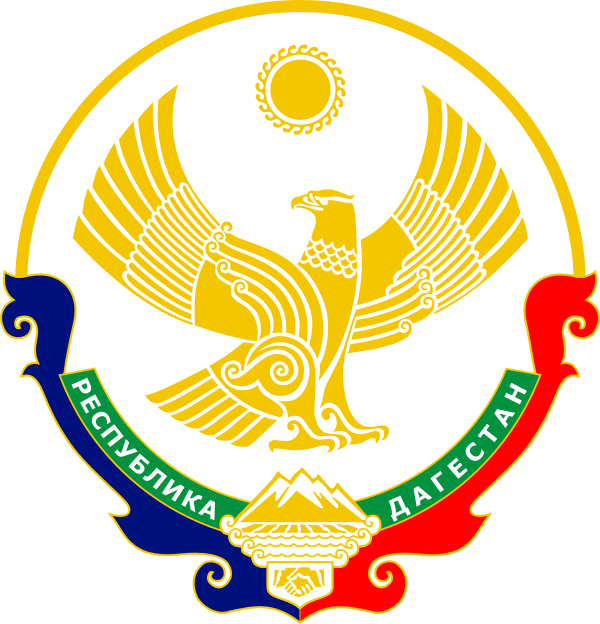
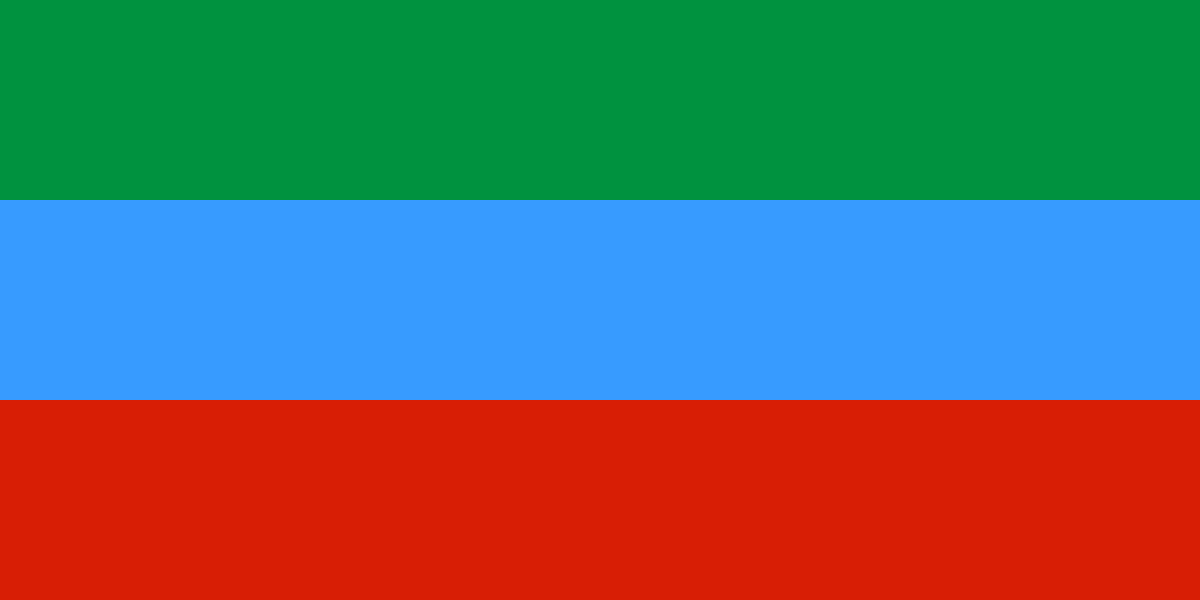
Regional flags and emblems
PROFILE
Established 20 January 1921 as the Dagestan Autonomous Soviet Socialist Republic
Dagestan Soviet Socialist Republic since 17 September 1991
The Republic of Dagestan since 17 December 1991
Capital Makhachkala
The Republic of Dagestan is part of the North Caucasus Federal District
Area 50,300 sq km
Population 3 259 900 (2026)
Ethnic groups
(2020 National Census, %)
Avar – 30,53
Dargin – 16,63
Kumyk – 15,84
Lezgin – 13,30
Lak – 5,19
Tabasaran – 4,03
Azerbaijani – 3,73
Russian – 3,26
Chechen – 3,17
Nogai – 1,18
Other – 3,14
The Republic of Dagestan is the most ethnically diversified region in the Russian Federation, with representatives of various nationalities, ethnic groups and three language groups.
Administrative divisions (2026)
Municipal districts – 41
City districts – 10
Rural towns – 7
Rural districts – 701
Geography and climate
The republic is located in the eastern part of the North Caucasus. The northern part is mostly lowlands, the southern is piedmont and mountains, the Big Caucasus. The eastern part borders on the Caspian Sea (the coast is 350 km long).
The republic borders the Republic of Kalmykia, the Chechen Republic and the Stavropol Territory as well as Azerbaijan and Georgia. It also has water borders (via the Caspian Sea) with Kazakhstan, Turkmenistan, Azerbaijan and the Islamic Republic of Iran.
There are four types of terrain in the region: lowlands, piedmont, mountains and high-altitude areas. The region has no equal in Russia in terms of diversity of plant and climatic zones: starting from subtropics at the mouth of the Samur River, deserts and semi-deserts in the north to high-altitude tundra, glaciers and alpine grasses.
The republic has a moderate continental climate, usually dry. The coldest month is January. The average January temperature is +0.7°С. Average July temperatures reach an average of +23.5°С.
The region is home to several federal protected natural sites: the Dagestan State Nature Reserve, Samursky National Park, three state nature sanctuaries (Agrakhansky, Tlyaratinsky and Samursky), and two botanical gardens. There are also regional protected natural sites: 12 state nature sanctuaries, four nature parks, 27 natural landmarks, and the Sulakskaya Laguna barrier-lagoon complex, coastal natural complex ”Papas“.
Government
The legislative branch is performed by the People’s Assembly – Parliament of the Republic of Dagestan, which is the permanent, supreme, representative and only body of legislative authority in the region.
The People’s Assembly has 90 deputies elected for five years in the single-number constituency, in proportion to the number of votes cast for the candidates.
The current People’s Assembly of the Republic of Dagestan was elected in September 2021 for a term of 5 years.
The executive branch is performed by: the Head of the Republic of Dagestan, the Government of the Republic of Dagestan and other executive bodies of state authority of the republic.
The Government of the Republic of Dagestan is the permanently functioning supreme executive body of state authority of the republic. The Government of the Republic of Dagestan is formed by the Head of the Republic of Dagestan and is responsible to his/her authority. The Government of the Republic of Dagestan directs the activities of executive bodies of the republic.
The Chairman of the Government of the Republic of Dagestan is appointed by the Head of the republic with the consent of the People's Assembly of the Republic of Dagestan, organizes the work of the Government and bears personal responsibility before the Head of the republic for the exercise of the powers vested in the Government of the republic.
The Head of the Republic of Dagestan is the highest-ranking official of the republic, heads the executive branch of the Republic of Dagestan and provides leadership over the activities of the Government of the Republic of Dagestan. The Head of the Republic of Dagestan is elected by the deputies of the People's Assembly of the republic for a term of 5 years. The term of office of the current Head of the republic expires upon the assumption of office by the person elected as Head of the Republic of Dagestan.
Economy and natural resources
The economy of the Republic of Dagestan is multi-industrial and specialises in agro-industrial development.
The agro-industrial sector, construction, manufacturing, transport, communications and trade play the main role in the gross regional product (GRP) and the region’s tax income.
Despite structural shifts occurring in industry, the food industry remains the main sectoral complex, whose products are widely known both within the country and abroad (JSC ”Kizlyar Cognac Factory“, JSC ”Derbent Sparkling Wine Factory“, JSC ”Derbent Cognac Combine“, OJSC ”Deneb“).
The main centres of mechanical engineering and metalworking are concentrated in Makhachkala, Izberbash, Kizlyar and Khasavyurt (JSC ”Dagdizel Plant“, OJSC ”Aviaagregat“, JSC ”Caspian Precision Mechanics Plant“, JSC ”Gadzhiev Plant“, JSC ”KEMZ Concern“). A significant place in the republic's mechanical engineering complex is occupied by enterprises of the Russian military‑industrial complex.
The production and distribution of electricity, gas and water in the republic is carried out on the basis of the energy complex, represented by hydroelectric power plants (Chirkeyskaya, Irganayskaya, Miatlinskaya, Chirurtskaya, Gotsatlinskaya), thermal power plants (Caspian, Makhachkala) and combined heat and power plants. The republic fully provides itself with electricity. Industrial use is made of non-traditional renewable energy sources: geothermal, wind, solar, and bioenergy.
The extraction of mineral resources is based on known oil and gas fields, non-ferrous metals (Kizil-Dere Mine) as well as construction materials (stone, quartz and glass sand, other sand and gravel mix and clays). The shelf of the Caspian Sea is an important reserve for hydrocarbons.
In addition to the main industries, construction materials, timber and chemical industries (fiberglass, mineral fertilisers and coatings) are well-developed in Dagestan.
The agro-industrial complex occupies a significant share in the structure of the GRP of the region. Dagestan is an ancient centre of terrace agriculture and livestock breeding.
Favourable climatic conditions in the region provide for agricultural development and specialisation in sheep and horse breeding as well as grape, fruit and vegetable gardening. Goat breeding is important in agriculture.
Cereals (rye, grain and corn), fruit, berry and potato as well as meat, dairy, wool, leather and egg production are the main agricultural spheres. Selective seed breeding has been actively developed recently.
The advantageous geographical location of the Republic of Dagestan, with its access to the Caspian Sea, plays an important role in the system of international Eurasian transport routes. The Republic of Dagestan has direct access to international transport flows and ensures Russia's economic links with the Transcaucasus, Central Asia, Kazakhstan, Turkey and Iran, and possesses significant potential for the transit of international flows between the Middle East and Europe. The share of the transport complex shows a tendency towards growth in transit cargo flows through the territory of the republic. The components of the transport‑logistics complex are: the Makhachkala Commercial Sea Port, JSC ”Makhachkala International Airport“, and railway, road and pipeline trunk lines.
Tourism and recreation are also among priorities in developing the republic’s economy. There is no place like Dagestan in Eurasia in terms of quality and quantity of climate and balneal resources in a relatively small area. The regional geothermal waters have a medicinal quality that surpasses that of other internationally renowned resorts. The Talgi Resort is the only balneal resort in the world based on sulfidic-heavy waters with hydrogen sulfides. The Talgi spring is unrivaled in Europe in terms of quality. The quality of water makes it possible to treat people with skin, gynecological and neurological diseases as well as the musculoskeletal system diseases.
Retail trade, the shoe industry and artisanal crafts are traditional areas in the region’s economy.
Culture and tourism
Dagestan offers a unique multitude of peoples and ethnic groups where all peoples have preserved their historical traditions, folklore, crafts and linguistic image. Many archeological, historical and mountain cultural landmarks help in developing domestic and international tourism.
Dagestan has more than 6,000 historical and cultural monuments, with over 170 federal monuments, five of which are included on the UNESCO list of world heritage sites: the Derbent Wall, the Derbent Lighthouse, the Dzhuma Mosque, the Naryn Kala part of the Derbent Fortress and the Armenian Church of the All-Saviour.
The diverse art and artisanal crafts of Dagestan are famous beyond the region. There are master goldsmiths from Kubachi, jewelers from Gotsatl, potters from Balkhar, woodworkers from Untsukul and carpet-makers from South Dagestan who are well-known and praised at world exhibitions and fairs. Their works are the most recognised and famous trademark of Dagestan.
The swimming season at the Caspian Sea lasts up to 140 days. There are about 160 tourist camps, guest houses, health resorts and children’s camps along the coast.
Dagestan’s unique climate and landscape provide for the development of alpine tourism.