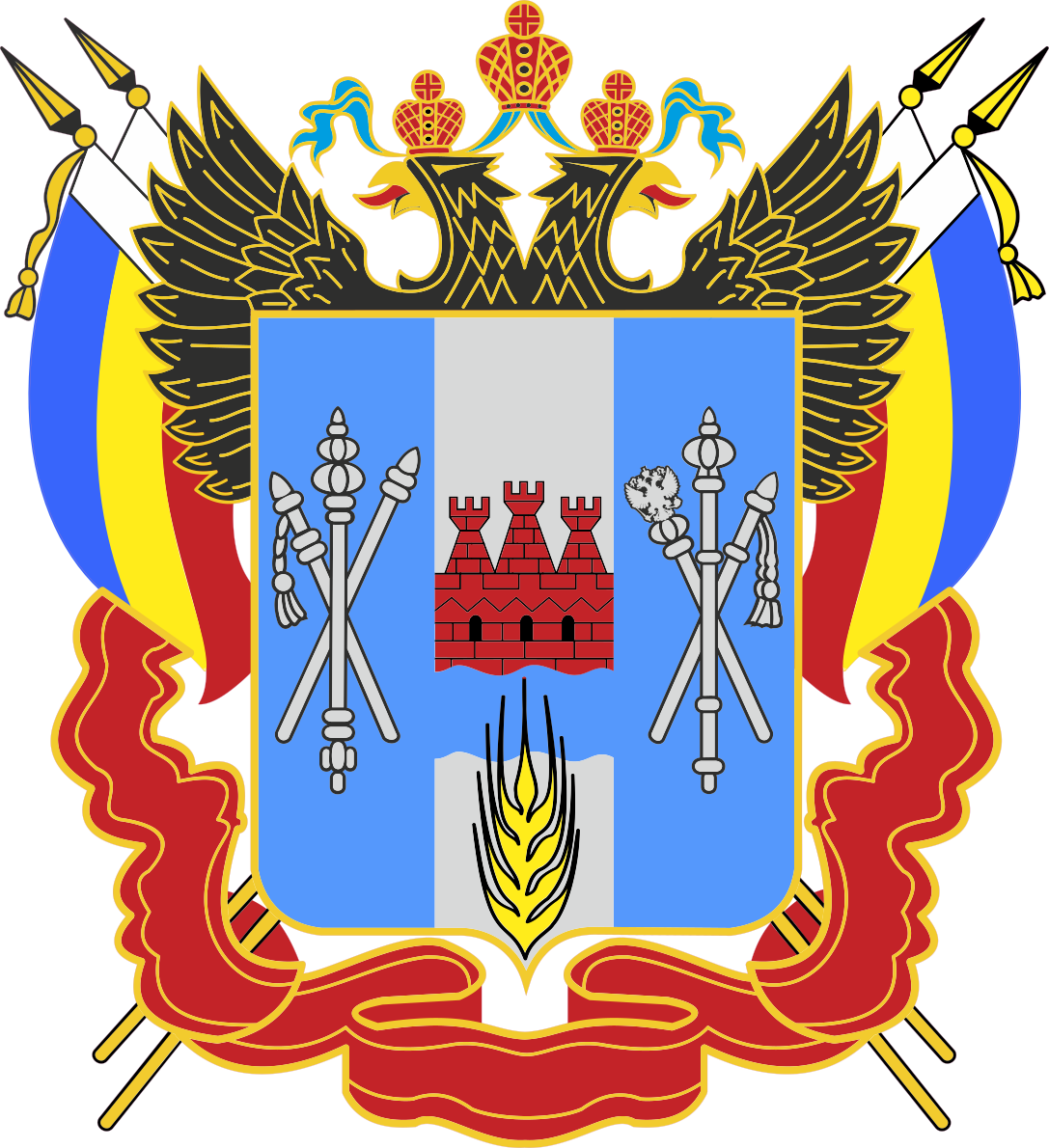
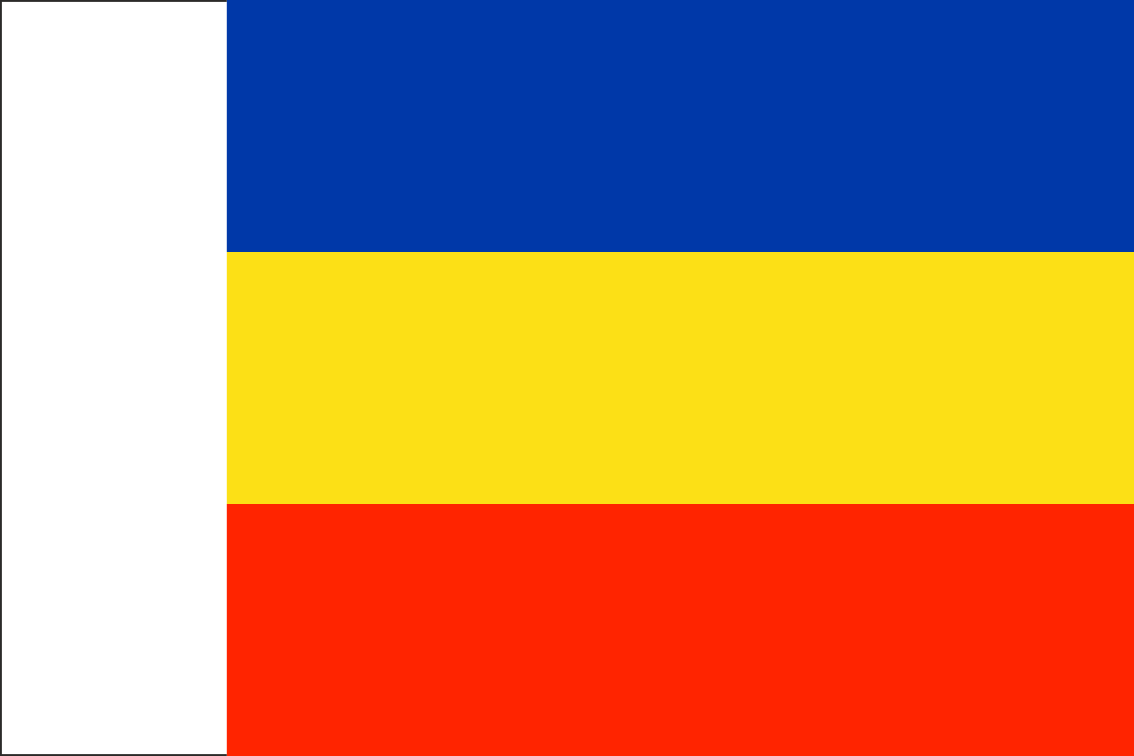
Regional flags and emblems
PROFILE
Established 13 September 1937
Capital Rostov-on-Don
The Rostov Region is part of the Southern Federal District
Area 101,000 sq km
Population 4 137 300 (2026)
Ethnic groups
(2020 National Census, %)
Russian – 91,69
Armenian – 2,19
Turk – 1,03
Other – 5,09
Administrative divisions (2026)
Municipal districts – 43
City districts – 12
Rural towns – 17
Rural districts – 391
Geography and climate
The Rostov Region is in the southern East European Plain.
The region borders on several Russian entities – the Republic of Kalmykia, the Lugansk People’s Republic, the Donetsk People’s Republic, the Krasnodar and Stavropol territories, and the Volgograd and Voronezh regions.
It also has a coastline along the Taganrog Bay on the Sea of Azov in the southwest.
The Rostov Region is located in the steppe zone. One of Europe’s largest rivers, the Don River, flows through the region. It is connected with the Volga River by a canal, creating a united river transportation system in the European part of Russia. The Volga-Don canal’s hydro-technical facilities serve as a basis for the water management system in the region, and include one of the largest reservoirs in the region – the Tsymlyanskoye water reservoir.
The region has a favourable, moderate continental climate. January temperatures average –3.0°C. July temperatures average 27.3°C.
The region is agglomeration of specially protected natural areas: the Rostov state biosphere reserve and Tsymlyansky state nature sanctuary, three public regional nature sanctuaries, three regional protected areas, 61 natural landmarks, 8 protected sites and Southern Federal University`s Botanical Garden.
Government
The legislative branch is the Legislative Assembly of the Rostov Region, which is the permanent, representative and only body of legislative authority in the region.
The Legislative Assembly of the Rostov Region consists of 60 deputies elected for five years, with 40 of them running in single-number constituencies and the other 20 in the single electoral district in proportion to the number of votes cast for lists of candidates nominated by electoral associations.
The current Legislative Assembly of the Rostov Region was elected in September 2023 for a term of 5 years.
The executive branch in the Rostov Region is represented by the Governor of the Rostov Region, the Government of the Rostov Region and other executive agencies of the region. The Government of the Rostov Region is the supreme and permanent executive body in the region.
The Governor of the Rostov Region is the region’s highest-ranking official, who exercises the executive authority in the region, forms and heads Government of the Rostov Region. The Governor is elected for five years by Russian citizens who permanently reside in the region. The current Governor's term of office expires in September 2030.
Economy and natural resources
The Rostov Region has one of the largest and most diverse industries in the southern part of Russia with highly developed agriculture, science and culture.
Manufacturing, production and distribution of electricity, natural gas and water, and mineral extraction account for the largest share of industrial production of the region.
The leading types of manufacturing are the mechanical‑engineering sector (LLC Combine Plant ”Rostselmash“, the ”Atommash“ branch of JSC ”AEM‑technologies“, LLC ”Novocherkassk Electric Locomotive Plant“), metallurgical production (PJSC ”Taganrog Metallurgical Plant“, LLC ”Rostov Electrometallurgical Plant“, OJSC ”Taganrog Boiler‑Building Plant Krasny Kotelshchik“, JSC ”Clever“) and food production (LLC ”GROUP AGROKOM“). Rostov Region possesses a range of high‑tech industries: helicopter‑building (PJSC ”Rostvertol“).
The production and distribution of electricity, gas and water are carried out on the basis of the energy complex, represented by the branch of the Rosenergoatom Concern – ”Rostov Nuclear Power Plant“, hydroelectric power stations, thermal power plants and combined heat‑and‑power plants (Tsimlyanskaya HPP, Novocherkasskaya GRES, Volgodonskaya CHP, Rostovskaya CHP, Shakhtinskaya GTES). The average level of gasification of the region exceeds 85%.
The Rostov Region is an energy-surplus region. This gives it a significant competitive advantage in attracting investors in new power-consuming industries.
The region has a developed transport infrastructure: it has railways and federal motorways, Platov Rostov-on-Don International Airport and regional Taganrog Yuzhny Airport. The region has three Sea ports (Rostov, Azov and Taganrog sea ports), two river ports (Volgodon river port and Ust-Donetsk river port). The transport industry accounts for about 10% of the regional GDP; it has consistent upward trends in increased cargo traffic through the region.
The Rostov Region is one of the largest producers of agricultural products in the Russian Federation. The production of agricultural products is dominated by the production of grain crops (autumn wheat, spring barley), grain legumes, gourds and oil crops (sunflower), as well as corn, millet, rice, buckwheat, pea and soy. The soils are favourable for viniculture combined with gardening. Livestock farming focuses on meat and dairy cattle breeding, pig breeding, sheep breeding, horse breeding and poultry farming. The region’s fishing industry is also highly developed.
Culture and tourism
The Don region attracts tourists with its rich history, charming nature, hospitable inhabitants, and distinctive Cossack culture. The Don River – one of Europe's largest rivers, with its branches and tributaries – the Sea of Azov and its Taganrog Bay, the Tsimlyansk Reservoir, and the Don and Azov steppes form the unique and memorable character of Rostov Region.
The Quiet Don is associated with the creative work of Alexander Pushkin, Mikhail Sholokhov, Nikolay Turoverov, Vitaly Zakrutkin, Anatoly Kalinin, Vladimir Fomenko, Vitaly Syomin, Anatoly Sofronov, and others.
Over a long period, a special community of people with their own way of life, shared interests, traditions and activities – the Don Cossacks – developed on the Quiet Don. The region's history is closely linked with the names of famous Don Cossacks of the 16th–18th centuries – Yermak Timofeyevich, Stepan Razin, Kondraty Bulavin, Yemelyan Pugachev, and Matvey Platov.
The glorious history of the Don is connected with the activities of the Russian emperors Peter I and Alexander I. The Quiet Don remembers the presence on its expanses of the military commander A.V. Suvorov and Admiral F.F. Ushakov, the historian V.D. Sukhorukov, the geographer I.V. Mushketov, the polar explorers G.Ya. Sedov and R.L. Samoilovich, the philosopher A.F. Losev, the battle‑painter M.B. Grekov, the sculptor E.V. Vuchetich, the writer A.M. Gorky, and others. The world‑famous writer A.P. Chekhov was born here.
The Don museums house unique collections of finds in gold from the Scythian‑Sarmatian period, an excellent ethnographic collection representing the diversity of national cultures of the Don region, items of Cossack everyday life, and canvases by renowned painters of the 18th–20th centuries.
Rostov Region has developed the tourist programme ”Silver Horseshoe of the Don“ – a tourist brand of the Don region, encompassing educational, ecological, ethnographic, rural and other types of tourism.
The territory of the region is home to archaeological heritage sites of federal significance, the most well‑known of which are the Tanais Archaeological Museum‑Reserve, the Nizhne‑Gnilovskoye Settlement, fragments of the 14th‑century Genoese fortress, and numerous burial mounds and necropolises.